New York City on Different Planets
Imagine to place New York City on another planet in our solar system. Life of course would cease to exist at least as we know it. You will realize once more that our beautiful blue planet is very rare. The following illustrations were made with the help of Marilyn Vogel.
Io’s Volcanoes are in the Wrong Place
Jupiter‘s moon Io is the most volcanically active world in the Solar System, with hundreds of volcanoes, some erupting lava fountains up to 250 miles high. Image © NASA/Johns Hopkins University Applied Physics Laboratory/Southwest Research Institute
A Different View of Home
Solar Terrestrial Relations Observatory B (STEREO-B) while observing the turbulent outer atmosphere (corona) of the Sun, gathered a novel view of our home planet and a celestial visitor in the inner solar system, Comet PanSTARRS. Image © NASA/GSFC/STEREO. Caption by Michael Carlowicz.
Visit nearby Stars
Visit nearby stars, a gorgeous video made in collaboration with The Barbarian Group for the 100 Year Starship foundation, showing some of the stars we might visit after our first journey 100 years from now. Have a look at the video…
Interplanetary Cessna
What would happen if you tried to fly an Interplanetary Cessna, a normal Earth airplane above our Solar System’s Planets or their moons? At this small images you can see what happens when the aircraft is trying to fly at 32 largest Planetary bodies.
Valles Marineris greatest Canyon in our Solar System [video]
Valles Marineris greatest Canyon in our Solar System (or Mariner Valley), is 4000 km (2500 mi) long and reaches depths of up to 7 km (4 mi)! Image credit: ESA/DLR/FU Berlin (G. Neukum)
The Cosmic Tourist
The Cosmic Tourist, a marvelous book written by the most well known astronomers of our time, Patrick Moore, Brian May and Chris Lintott, presenting us with a beautiful way the 100 most stunning destinations in the Universe.
Mars Interior
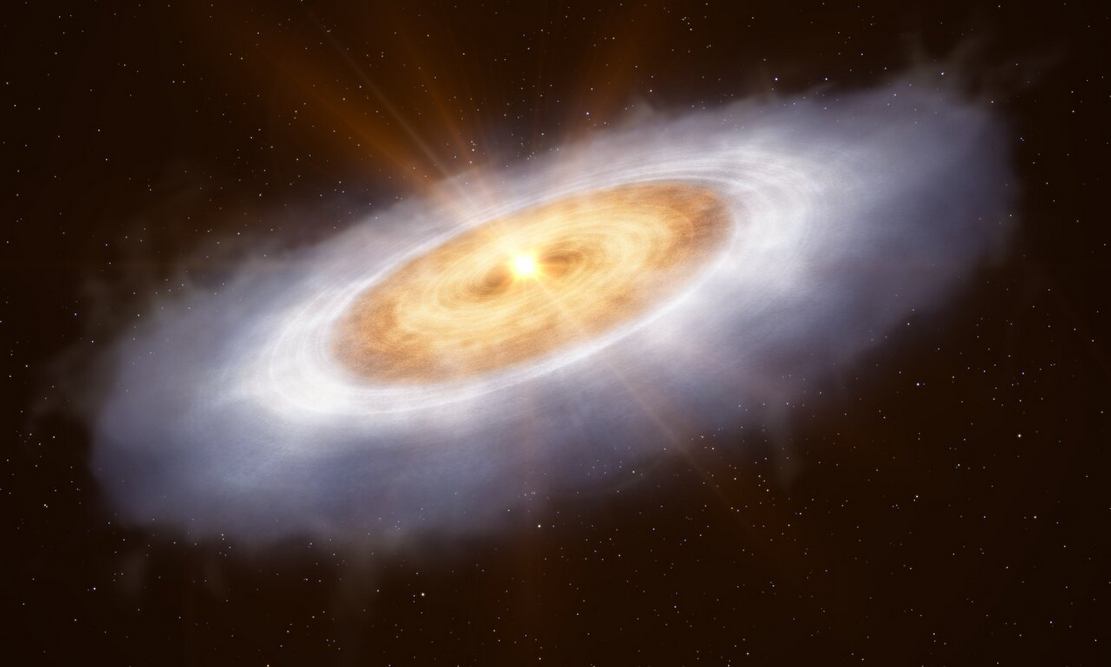
Artist rendition of the formation of rocky bodies in the solar system – how they form and differentiate and evolve into terrestrial planets. Image credit: NASA/JPL-Caltech
Why is Earth so dry?
Earth with large oceans, rivers and glaciers near the North and South poles, doesn’t seem to have a water shortage. But the fact is that she is 99-percent dry rock. Only less than 1 percent of its mass is water!
Astronomer insists there is a Planet X
Rodney Gomes, an astronomer at the National Observatory of Brazil in Rio de Janeiro, says that the distortion to orbits of asteroids at the end of our solar system, beyond Pluto, imply that a mystery planet is orbiting our sun. Image credit: NASA/JPL-Caltech