

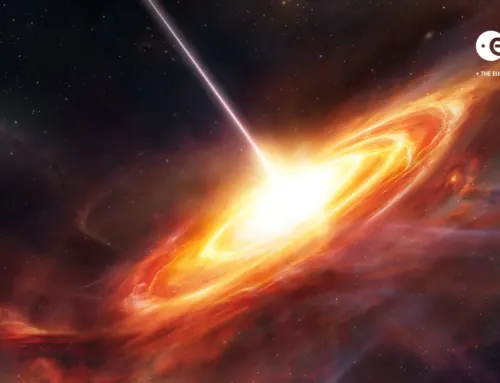
 This illustration shows an exoplanet. ESO/M. Kornmesser, L. Calçada
A team of astronomers led by the University of California, Irvine has discovered a new Earth-like exoplanet orbiting a star in the habitable zone, about 25 light-years away.
The newly discovered planet, GJ 3378b, joins the growing number of worlds that could support life.
GJ 3378b is about twice Earth’s size and orbits within its star’s habitable zone, the region where temperatures may allow liquid water to exist on a planet‘s surface.
One big question remains: does the planet have an atmosphere? GJ 3378b lies near the cosmic shoreline, a boundary where intense stellar radiation can strip away a planet’s atmosphere. Mars is thought to have experienced this process long ago, losing much of the atmosphere it may once have had.
Although GJ 3378b is a promising candidate for habitability, astronomers will need more powerful future telescopes to determine whether it still has an atmosphere and if it could truly support life.
“This one’s exciting,” said Paul Robertson, UC Irvine associate professor of astronomy and lead author of the new study, published in The Astrophysical Journal. “It’s one of our closest cosmic neighbors. 25 light-years sounds like a long way, but the Milky Way is about 100,000 light-years across, so in that respect it’s our next-door neighbor.”
Why it matters:
Every new potentially habitable planet brings scientists closer to answering one of humanity’s biggest questions: Are we alone in the universe? GJ 3378b is close enough to become an important target for future telescopes searching for atmospheres and possible signs of life.


Leave A Comment