

 The new map SPICE-RACS, shows magnetic fields throughout the Universe in blue and red. CSIRO/Alec Thomson et al./Alex Cherney/Sam Moorfield
The largest magnetic map of the Universe reveals the invisible cosmos.
Scientists have created the most detailed map ever made of magnetic fields stretching across the Universe, bringing researchers one step closer to understanding how energy moves through intergalactic space. The new map covers an area more than five times larger than all previous studies combined.
 CSIRO Murchison Radio-astronomy Observatory. CSIRO/Alex Cherney
The project was led by researchers from Australia’s national science agency, CSIRO, together with the SKA Observatory (SKAO), using the powerful ASKAP radio telescope in Western Australia.
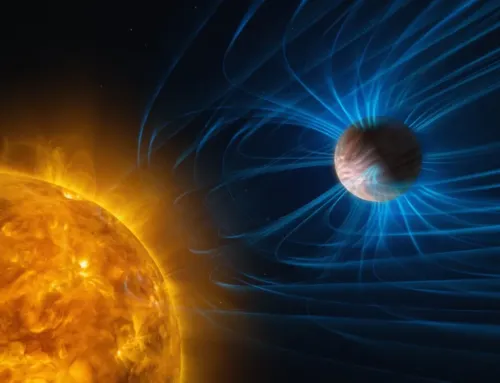
Magnetic fields cannot be seen directly, making it easy to overlook their importance. Yet they play a crucial role throughout the cosmos. On Earth, our planet’s magnetic field shields us from harmful solar radiation and charged particles from the Sun. Without this protection, life as we know it would be far more difficult to sustain.
 CSIRO/Alec Thomson et al./Alex Cherney/Sam Moorfield
The new map was created using observations from ASKAP at Inyarrimanha Ilgari Bundara in Western Australia. The telescope continuously scans the sky for radio signals as part of the Rapid ASKAP Continuum Survey (RACS). In 2020, ASKAP completed the largest and fastest radio survey of the sky ever conducted.
Known as SPICE-RACS, the new magnetic map takes advantage of a phenomenon called Faraday rotation, where radio waves twist as they pass through magnetic fields. By measuring this twisting effect, astronomers can determine where magnetic fields exist and estimate their strength across vast regions of space.
 CSIRO/Alex Cherney/Tom Fowler
Much of the Universe remains invisible in ordinary light, so our understanding of cosmic structures depends heavily on advanced instruments capable of detecting radio waves and other forms of radiation. Projects like SPICE-RACS are helping scientists uncover the hidden magnetic network that influences galaxies, cosmic matter, and the flow of energy throughout the Universe.
“We collected rotation measures from every galaxy detected in RACS – nearly four million galaxies – and reprocessed this original data from ASKAP to retrieve the full picture,” Thomson says.
“For the first time, we can investigate fine details of the material between nearby stars, and study a huge number of distant galaxies,” says lead researcher Dr Alec Thomson, commissioning scientist with the SKAO.
Why it matters:
In simple terms, this map gives astronomers a new way to see one of the Universe’s invisible forces. Just as mapping gravity helped explain the motion of planets and galaxies, mapping cosmic magnetism could reveal how the Universe is organized and how it evolved over billions of years.



Leave A Comment