

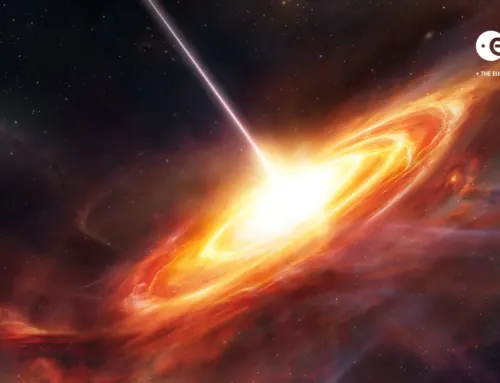
 The artistic rendering of the supermassive black holes at the center of galaxy Markarian 501. © Emma Kun / HUN-REN Konkoly Observatory / Made with the support of AI
A new study of the unusual light coming from the blazar galaxy Mrk 501 suggests something surprising: there may be two supermassive black holes in its center, not just one.
Each one could be producing its own powerful jet of matter. This isn’t fully proven yet, but according to astronomer Silke Britzen and her team at the Max Planck Institute for Radio Astronomy, it’s the best explanation so far for what we’re seeing.
Scientists already believe that almost every large galaxy has a supermassive black hole at its center, millions or even billions of times heavier than the Sun. But how they grow so massive is still a mystery. Simply pulling in gas would take too long, so they likely grow by merging with other black holes when galaxies collide.
Galaxy collisions are common in the universe, so these black hole mergers should happen, too. But the final stages of that process are still not well understood. Until now, no close pair of supermassive black holes had been clearly confirmed.
That may be changing.
By studying 23 years of detailed radio observations, the team found something unusual in Mrk 501: not one jet, but two. This is the first time such a system has been directly imaged at a galaxy’s core, strongly suggesting a pair of black holes.
One jet is pointed toward Earth, making it bright and easy to spot. The second jet is angled differently, which made it harder to detect. Over just a few weeks, scientists saw it move in a looping pattern, likely caused by the motion of two black holes orbiting each other.
At one point, the light even appeared as a ring (an Einstein ring), likely caused by gravitational lensing—where one black hole bends the light from the other behind it.
 The graphical depiction shows the central region of the galaxy Mrk 501 at a frequency of 43 gigahertz on three different days. © S. Britzen
Why it matters:
If confirmed, this would be one of the clearest signs yet of two supermassive black holes about to merge. That helps scientists understand how these giants grow—and could also improve our ability to detect gravitational waves, the ripples in space-time produced when massive objects like black holes collide.

Leave A Comment