

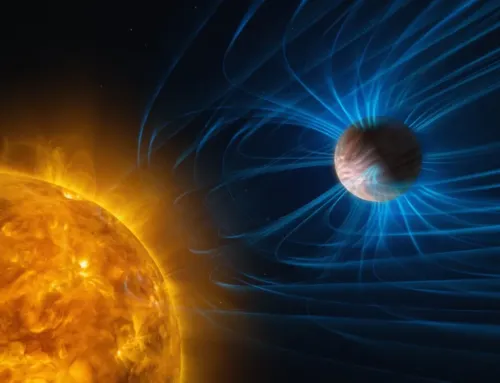
 Some Exoplanets may have Magnetic Fields. © Credit: ESO/M. Kornmesser, L. Calçada
Astronomers have found the strongest evidence so far that some exoplanets have magnetic fields.
Using the European Southern Observatory’s Very Large Telescope (ESO’s VLT) and the Gemini North telescope in Chile and Hawaii, researchers studied powerful winds in the atmospheres of seven extremely hot giant exoplanets. The way these winds move suggests they are being influenced by magnetic fields, similar to those found on Earth and several other planets in our Solar System.
Magnetic fields are invisible shields created by the movement of electrically conductive material, such as molten metal, deep inside a planet. They can help protect a planet from harmful radiation and charged particles from its star.
The planets in this study are known as “hot Jupiters,” gas giants similar in size and composition to Jupiter, but orbiting much closer to their stars. Because of this, one side of each planet constantly faces the star while the other remains in permanent darkness, much like the Moon always shows the same face to Earth. Some of these planets are up to three times more massive than Jupiter.
Although these hot Jupiters are not considered suitable for life, the discovery provides an important clue about how planets work and evolve.
Why it matters:
It is the strongest evidence yet that exoplanets can have magnetic fields.
Magnetic fields help protect planetary atmospheres from being stripped away by stellar radiation.
They are considered an important ingredient for making rocky planets like Earth potentially habitable.
The discovery gives scientists a new way to study the interiors and evolution of distant worlds.
It brings researchers one step closer to identifying planets that may have conditions suitable for life.



Leave A Comment