

 Scientists have found more than 6000 of exoplanets throughout the Milky Way. © NASA GSFC
The Paranal solar ESPRESSO Telescope (PoET), installed at the European Southern Observatory site in Chile, has captured its first observations of exoplanets.
The new solar telescope will work together with ESO’s ESPRESSO instrument to study the Sun in great detail.
Known as a “solar telescope for planet hunters,” PoET is designed to help scientists understand how changes in starlight can hide the signals of planets orbiting distant stars. This could improve the search for worlds beyond our Solar System.
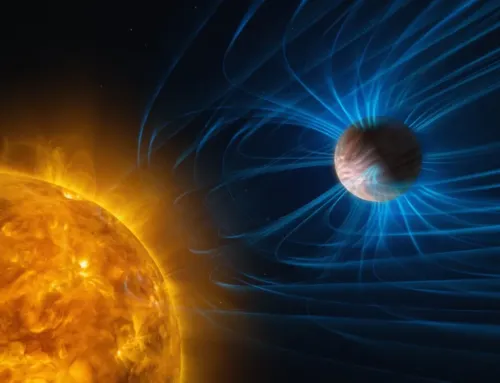
Most exoplanets are discovered by studying the light from their host stars, especially tiny changes in a star’s spectrum. The light is split into different colors and frequencies. But activity on a star’s surface, similar to sunspots on the Sun, creates extra signals that can either hide or imitate the signs of orbiting planets. This “noise” makes finding exoplanets more difficult.
To solve this problem, scientists are turning to the Sun, the closest star to Earth. By studying how solar activity changes sunlight, researchers hope to better understand the same effects seen on distant stars.
 PoET’s main telescope, seen here being lowered into its dome, has a 60-cm mirror. © ESO
PoET completed its first test observations in early April at ESO’s Paranal Observatory in Chile’s Atacama Desert. Early results show the system is working as expected and can collect spectra from both the entire Sun and smaller regions, such as sunspots. The team will continue testing and fine-tuning the system before starting full scientific operations.
The telescope features a 60-centimeter mirror that can focus on specific areas of the Sun to study signs of stellar activity. It also includes a smaller telescope that observes the entire visible solar disc.
PoET works with ESPRESSO, one of the world’s most advanced exoplanet-hunting instruments, installed on ESO’s Very Large Telescope. Usually used at night to study distant stars, ESPRESSO will now also analyze sunlight during the day, together with PoET.
Why it matters:
PoET could help astronomers separate stellar “noise” from real planetary signals, making it easier to detect smaller Earth-like exoplanets around Sun-like stars. This may improve the accuracy of future planet discoveries and help scientists identify potentially habitable worlds more reliably.

Leave A Comment