

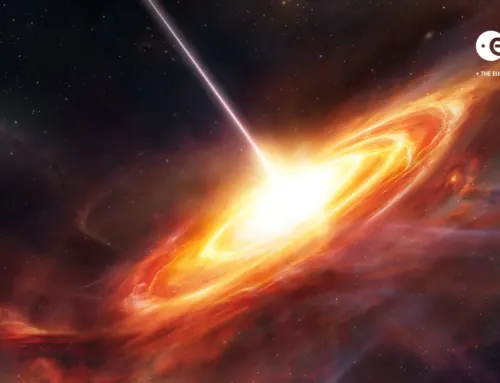
 Mystery about the Star Gamma Cassiopeiae. © ESA, Y. Nazé
The XRISM space telescope has finally solved a 50-year mystery about the bright star Gamma Cassiopeiae.
Astronomers discovered that an unseen companion, a white dwarf, is slowly pulling in material from the star. This process creates the strange X-rays that scientists couldn’t explain for decades.
Using very precise observations, XRISM showed that these X-rays change along with the companion’s orbit, proving it is the source of the radiation.
Gamma Cassiopeiae is easy to spot in the night sky and forms the middle point of the “W”-shaped Cassiopeia constellation. Despite being well known, it has puzzled scientists since 1866, when Angelo Secchi noticed unusual features in its light.
 Star Gamma Cassiopeiae. © ESA
This led to the discovery of a special type of star called Be stars, which are fast-spinning stars surrounded by discs of gas they throw off into space.
“There has been an intense effort to solve the mystery of gamma-Cas across many research groups for many decades. And now, thanks to the high-precision observations of XRISM, we have finally done it,” says Yaël.
Two different theories:
For years, scientists had two main ideas to explain the powerful X-rays from Gamma Cassiopeiae.
One idea was that the star’s magnetic fields were interacting with the gas disc around it, heating the material and creating X-rays.
The other idea was that a hidden white dwarf companion was pulling in gas from the star, producing X-rays as it fed.
Now, the XRISM telescope has provided the answer. Its advanced instrument showed that the hot gas responsible for the X-rays moves in sync with the orbit of the unseen companion.
This proves that the white dwarf is the source, it is slowly absorbing material from the star and emitting X-rays in the process.
 Mystery about the Star Gamma Cassiopeiae. © ESA, Y. Nazé
Earlier observations from XMM-Newton helped narrow down the possibilities, allowing XRISM to confirm the correct explanation finally. As researcher Yaël Nazé said, it’s very satisfying to solve this long-standing mystery finally.
This discovery not only explains the strange X-rays but also raises new questions about how these star systems form. Scientists once thought such pairs were common, especially among smaller stars, but now it seems they are rarer and mostly found around massive Be stars.
source ESA



Looks and sounds like the ‘BE’ star is giving the little ‘companion’ an injection boost to get his ass back home inside the ‘BE’ stars influence.