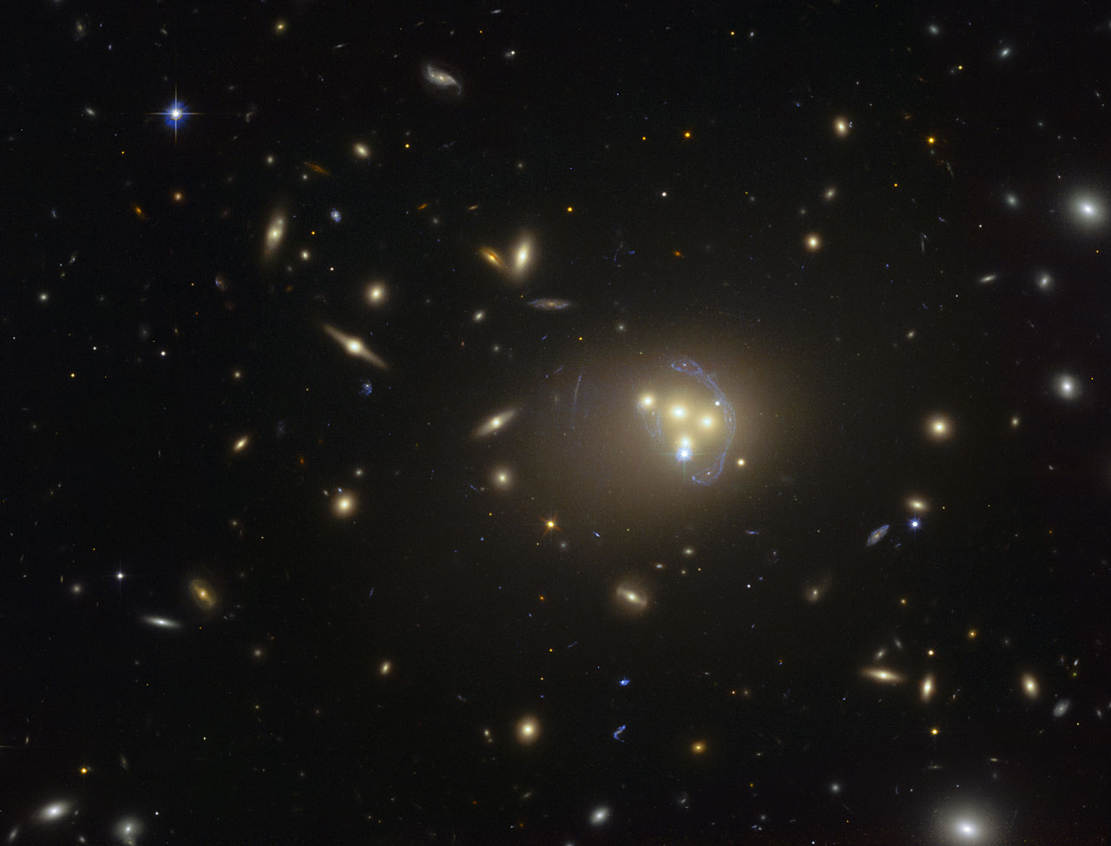
Pulsar takes tests of General Relativity into new territory
Astronomers using ESO’s Very Large Telescope, along with radio telescopes around the world, they find and study a bizarre stellar pair consisting of the most massive neutron star, orbited by a white dwarf star. This strange new binary allows tests of Einstein’s theory of gravity — general relativity — in ways that were not possible up to now.
Biggest Black Hole Blast Ever
Astronomers have found biggest Black Hole blast ever, in the heart of a Quasar burning 100 times as much energy as the entire Milky Way galaxy. Image credit: ESO
Lost in Space- free-floating Planet spotted
Astronomers using ESO’s Very Large Telescope and the Canada-France-Hawaii Telescope have identified a body that is very probably a planet, a free-floating Planet, wandering through space without a parent star. Image credit: ESO Watch the video…
It’s full of stars!
This full of stars image by NASA/ESA Hubble Space Telescope, offers an impressive view of the center of Globular cluster NGC 6362. The image of this spherical collection of stars takes a deeper look at the core of the globular cluster, which contains a high concentration of stars with different colors. Image credit: ESA/Hubble & NASA
9-Billion-Pixel Photo of Milky Way Center
This new gigantic 9-Billion-Pixel photo of Milky Way’s center, from the VISTA infrared survey telescope at ESO’s Paranal Observatory, contains more than 84 million stars. Image credit: ESO/VVV Consortium. Acknowledgement: Ignacio Toledo, Martin Kornmesser
Earth-size exoplanet discovered in our nearest Star System
An Earth-size exoplanet discovered by scientists, in our nearest Star System, in Alpha Centauri 4.3 light-years away from us. Artist’s impression of the planet around Alpha Centauri B. Credit: ESO.
Celestial Witch’s Broom
The Pencil Nebula also known as NGC 2736, is pictured in a new image from ESO’s La Silla Observatory in Chile. This peculiar cloud of glowing gas is part of a huge ring of wreckage left over after a supernova explosion that took place about 11 000 years ago. This detailed view was produced by the Wide Field Imager on the MPG/ESO 2.2-metre telescope.
Finding Life- Special ESO 50th anniversary episode
In this special episode, prepared for their 50th anniversary, ESO is looking at one of the greatest quests that astronomers have pursued over the centuries: the search for life in the Universe. ESO has played an important role in this exciting journey. Scroll down for video
Vampire star and its victim
Using ESO’s Very Large Telescope (VLT) astronomers has shown that most very bright high-mass stars, which drive the evolution of galaxies, do not live alone. Many of such binaries transfer mass from one star to another, a kind of stellar vampirism depicted in this artist’s impression. Image credit: ESO/M. Kornmesser/S.E. de Mink
Centaurus A radio galaxy, as seen by ALMA
This new image of the centre of the distinctive galaxy Centaurus A, made with the Atacama Large Millimeter/submillimeter Array (ALMA), shows how the new observatory allows astronomers to see through the opaque dust lanes that obscure the galaxy’s centre, with unprecedented quality. Image credit: ALMA (ESO/NAOJ/NRAO); ESO/Y. Beletsky