Expedition 30 Soyuz rolls to the Pad
The Soyuz TMA-03M spacecraft is rolled out by train on its way to the launch pad at the Baikonur Cosmodrome, Kazakhstan, Monday, Dec. 19, 2011.
Apollo 13 checklist brings $388,375 at Auction
The Apollo 13 Lunar Module Systems Activation Checklist upon which Commander James Lovell made his handwritten calculations to guide his wounded spacecraft and crew home – scant two hours after uttering the famous words, “Houston, we’ve had a problem.” – consigned by Commander Lovell himself, brought $388,375 today as the centerpiece of Heritage Auctions’ Nov. 30 Space Signature(R) Auction.
Expedition 29 Crew Lands
Russian support personnel work to help get crew members out of the Soyuz TMA-02M spacecraft shortly after the capsule landed with Expedition 29 Commander Mike Fossum and flight engineers Sergei Volkov and Satoshi Furukawa in a remote area outside of the town of Arkalyk, Kazakhstan, at 9:26 p.m. EST on Monday, Nov. 21, 2011 (8:26 a.m. Tuesday, Nov. 22, 2011, Kazakhstan time). Image Credit: NASA/Bill Ingalls
Mass Is Energy
The USS Enterprise in 1964 (pre Zefram Cochrane era), during Operation Sea Orbit when it sailed around the world in 65 days without refuelling – demonstrating the capability of nuclear-powered ships. Credit: US Navy.
Some say that the reason you can’t travel faster than light is that your mass will increase as your speed approaches light speed – so, regardless of how much energy your star drive can generate, you reach a point where no amount of energy can further accelerate your spacecraft because its mass is approaching infinite.
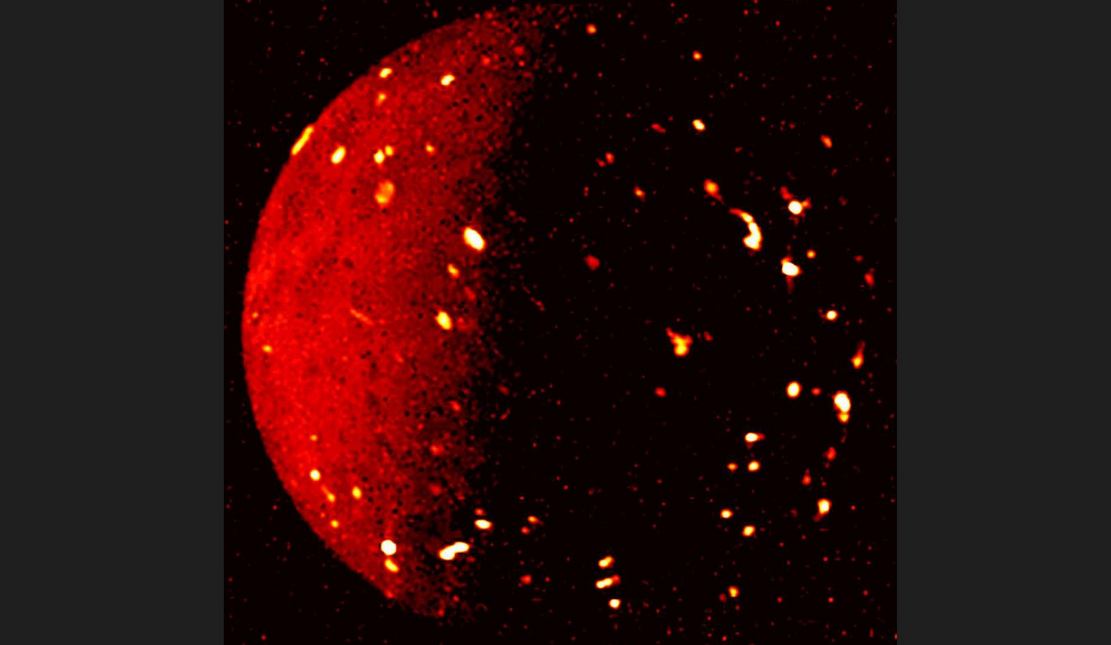
Major eruption in volcanic Moon Io
This NASA montage of New Horizons images shows Jupiter and its volcanic moon Io, taken during the spacecraft’s Jupiter flyby in early 2007. The image shows a major eruption in progress on Io’s night side, at the northern volcano Tvashtar. Incandescent lava glows red beneath a volcanic plume, whose uppermost portions are illuminated by sunlight. The plume appears blue due to scattering of light by small particles within it. Picture: NASA/Johns Hopkins University Applied Physics Laboratory/Southwest Research Institute/Goddard Space Flight Center/AFP
Soyuz TMA-21 Lands
The Soyuz TMA-21 spacecraft is seen as it lands with Expedition 28 Commander Andrey Borisenko, and Flight Engineers Ron Garan, and Alexander Samokutyaev in a remote area outside of the town of Zhezkazgan, Kazakhstan, on Friday, Sept. 16, 2011.
Asteroids sizes
This composite image shows the comparative sizes of nine asteroids. Up until now, Lutetia, with a diameter of 81 miles (130 kilometers), was the largest asteroid visited by a spacecraft, which occurred during a flyby. Vesta dwarfs all other small bodies in this image.
Scene from Star Wars or a Real Image?
Astronaut Ron Garan posted the image on, asking viewers if they thought the spacecraft looked like the fictional fighter jets of the Alliance.
Rhea and Titan, Saturn’s largest moons
A color-composite image of Rhea and Titan, Saturn’s largest moons. Made from raw images acquired by the Cassini spacecraft on June 16, 2011, this really shows the vast difference in size and appearance of the two moons.